
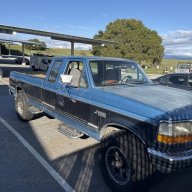
93 7.3 IDI – Dies at 2nd/3rd stop after driving, hard restart, air or DB2?

jrez

Registered User
Joined
Mar 1, 2026
Posts
4
Reaction score
5
Location
Santa Cruz, California
Hello everyone,

I’m in college and got this truck as my first vehicle and I’m very new to IDIs. I’m still learning, so I really appreciate any guidance you can offer.

When I first got this truck (1993 F-250 7.3 IDI), it still had the original tank and completely rotted supply lines. Even with those, I was able to drive it about 30 miles out of town and around 16 miles back before it slowly died on me and I got it to the side of the road.

Since then, I’ve replaced quite a bit trying to do this the right way:

- New fuel tank
- New tank pickup unit
- New supply lines
- New selector valve (standard FV5K
- New electric fuel pump (Precision E16287)
- New fuel filter

- Previous owner had already installed new return lines and was running an old Carter electric pump as well. They also bypassed the glow plug relay with a button inside the cab.

Right now I’m seeing about ~5 PSI at the Schrader with key on (engine not running), and this is the issue I'm running into:
- Will only start with ether. Once started, idles fine.
- It drives fine initially and doesn’t die at the first stop. By the 2nd or 3rd full stop, it dies pretty suddenly (like someone turned the key off) and doesn’t slowly lug like before with the rotted lines.
- After it dies, it’s hard to restart even with ether. Feels like it’s trying to catch but wont start.
- If I crack injector lines and bleed them while idling, the idle smooths out noticeably.

It’s not behaving like the original slow fuel starvation or air intrusion from the rotted lines and it’s more sudden now once warm and coming to a stop.

I’m trying to figure out whether this sounds more like:
- Small air intrusion somewhere (supply or return side) I also lowered the tank agin and retightened each hose clamp.
- Or internal case pressure is unstable / worn DB2 once warm.

For context, the injection pump appears original and is pretty caked in old diesel grime.

I’m completely open to testing things. If you guys think I should:
- Run supply/return from a diesel can to isolate (i had this setup for a while with a jerry can as the tank in the back of the cab with the pump and everything inside too)
- Redo return caps/O-rings,
- Fill filter with atf to try lubricating the advance piston?
-Or anything else

I’m just trying to diagnose properly instead of throwing random parts at it.
Thanks in advance, I really appreciate the knowledge in this community!

J.P.

 

IDIBRONCO

IDIBRONCO
Joined
Feb 5, 2010
Posts
15,051
Reaction score
14,149
Location
edmond, ks
First off, you have to realize that you have more than one issue here. That will make the rest easier to deal with.
Will only start with ether. Once started, idles fine.
This, for sure, is one issue. Since you didn't say, I'm assuming that once the engine's warm, it will start fairly easily if you shut off the key to stop the engine. This is a glow plug issue. You can check this by plugging in the block heater if it's all there and working. Leave it plugged in for 3-4 hours and then try to start the engine. If it starts easily, then you've confirmed a glow plug issue.
- After it dies, it’s hard to restart even with ether. Feels like it’s trying to catch but wont start.
- If I crack injector lines and bleed them while idling, the idle smooths out noticeably.
These indicate an air intrusion issue. Leaking return line o rings won't affect the way the engine runs once it's running and all of the air has been bled out. That's because they are "after" the injectors and they also won't allow air into the fuel system while they're leaking fuel externally.
- Or internal case pressure is unstable / worn DB2 once warm.
I'm not going to say that this isn't your issue with the engine dying after a couple of stops while driving, but I think that it's very unlikely. Too much wear in the IP almost always leads to an issue where the engine won't restart without a lot of cranking on the starter after the hot engine's been shut off for 30 or so minutes. While the engine's running, the worn internals will still be able to pump enough fuel to the injectors to keep the engine running. You can test this the next time the engine dies at a stop. Pour some lukewarm/cool water over the IP. That will cool it off and shrink the internal tolerances causing it to then pump enough fuel for the engine to start.
- Fill filter with atf to try lubricating the advance piston?
This might not help, but it sure won't hurt. If it doesn't, all you'll be out is some ATF and a new filter if you use one.
For context, the injection pump appears original and is pretty caked in old diesel grime.
This might mean that it's worn out and needs to be replaced. The bad news is that, for the best results, the IP and injectors should be replaced as a set. They wear internally at the same rate. All of the You Tube videos that talk about only replacing one and not both are WRONG. It's not fixing the whole wear problem. As expensive as they are, I recommend trying to diagnose farther as opposed to just replacing the IP or injectors.
- Run supply/return from a diesel can to isolate (i had this setup for a while with a jerry can as the tank in the back of the cab with the pump and everything inside too)
This isn't a bad idea to try. If you can secure the can enough to drive the truck, you can check to see if the dying at a stop still occurs.
- New electric fuel pump (Precision E16287)
I'm not sure what type of pump this is, but it's possible that it's not able to supply enough fuel to the engine. If that's the case, then that is most likely your whole supply issue.
Remember that this will take time. You will have to work through a lot of neglect. Once you're done, you should have a pretty good running truck.
 

jrez

Registered User
Joined
Mar 1, 2026
Posts
4
Reaction score
5
Location
Santa Cruz, California
These indicate an air intrusion issue. Leaking return line o rings won't affect the way the engine runs once it's running and all of the air has been bled out. That's because they are "after" the injectors and they also won't allow air into the fuel system while they're leaking fuel externally.

I really appreciate your response.
If this does sound like air getting in somewhere, where would you suggest I focus first?

Right now the supply line from the selector valve to the filter head is a single uninterrupted hose (no barbed or male-to-male connectors), and I lowered the tank again and re-tightened all hose clamps just to be sure.

I’m trying to narrow down where air would realistically be entering from areas like:
- Suction side from tank → selector valve → electric pump?
- Pump inlet fittings?
- Or is it possible for air to enter at the injection pump itself from the seals once warm?

Is there a good method to isolate sections of the system to pinpoint it? I’ve seen people install a short section of clear line before the IP to check for bubbles. Or do you know of any other specific tests that you’d recommend to identify exactly where air might be entering?

Also, regarding the glow plug suggestion, if there is indeed air being introduced into the system, I’m wondering how that would affect the block heater test. If I plug it in for 3–4 hours but there’s still air being introduced in the system, it may still be difficult to start even if the glow plugs are working properly. Would it make sense to isolate the fuel system with a jerry can first before doing the block heater test, or is there a better way to separate glow plug issues from fuel/air issues cleanly?

Thanks again, I really appreciate you taking the time to help.
 

IDIBRONCO

IDIBRONCO
Joined
Feb 5, 2010
Posts
15,051
Reaction score
14,149
Location
edmond, ks
Would it make sense to isolate the fuel system with a jerry can first
If this does sound like air getting in somewhere, where would you suggest I focus first?

I feel like your best bet is to focus on one issue at a time. Personally, I think I would try this first. That way you can see how the engine runs. If you can get a good running engine, you'll probably feel more confident in tackling the other issues.
Suction side from tank → selector valve → electric pump?
These are places where air could get in.
Pump inlet fittings?
I don't believe that this could let in air while the engine's running. In theory, there should be pressure here while the engine's running. When the engine's not running, air could get in here though. I'd still try to concentrate on one thing at a time. Like while the engine's running.
- Or is it possible for air to enter at the injection pump itself from the seals once warm?
I don't know enough to be confident in answering this. I'm probably as likely to be wrong as I would be to be right.
is there a better way to separate glow plug issues from fuel/air issues cleanly?
I don't believe so. That's why I emphasize fixing one thing at at time.
 

IDIBRONCO

IDIBRONCO
Joined
Feb 5, 2010
Posts
15,051
Reaction score
14,149
Location
edmond, ks
After thinking about this at work this morning, I have a new suggestion. If the ATF soak and the separate fuel container don't yield positive results, I think that your next step should be to install a fuel pressure gauge that you can watch while driving. The above mentioned symptoms do "indicate" air intrusion like I said, but they aren't 100% proof of it. Lack of sufficient fuel supply can also make similar symptoms. I installed a fuel pressure gauge after fighting similar symptoms. Mine turned out to be a bad lift pump (lack of fuel supply) and that ended up taking out my IP.
 

jrez

Registered User
Joined
Mar 1, 2026
Posts
4
Reaction score
5
Location
Santa Cruz, California
Thanks for the advice, I really appreciate the help. I went ahead and went back to the old in-cab jerry can setup I had been using before doing all the recent fuel system work so I could isolate that stuff completely.

Started a little rough and needed a bit of help (so there’s still a glow plug issue to address later), but once it was running it idled fine and I was able to drive it around without the random shutoff at stops like before.
I think that your next step should be to install a fuel pressure gauge that you can watch while driving. The above mentioned symptoms do "indicate" air intrusion like I said, but they aren't 100% proof of it.
Pretty much what you said earlier, this seems to confirm the issue is somewhere in the truck’s fuel plumbing. I plan on going back through the suction side starting at the tank pickup/sender, then the selector valve, and the lines leading to the lift pump to see where air might be getting in.

I’ll definitely take your advice and look into a gauge to monitor pressure while driving. If I end up adding a gauge pod later, are there other gauges you would recommend running on these trucks besides fuel pressure and maybe a pyrometer?

Thank you very much.
 

IDIBRONCO

IDIBRONCO
Joined
Feb 5, 2010
Posts
15,051
Reaction score
14,149
Location
edmond, ks
Before you start randomly redoing the suction side, crawl underneath and take a close look at every part of it. Use a light if you have to. Sometimes you can see a damp place that would indicate fuel seepage. If if can get out with the engine off, air can get in while it's running. It's kind of a pain, and it might not turn up anything, but it can also help to eliminate quite a bit of guess work if you can see something and then it will be worth it.
By running the engine off of a can and then driving the truck to try to recreate the dying issue, you've also eliminated the lift pump and the injector pump as possible causes.
Another gauge that I consider to be essential, and one that will be in every IDI powered vehicle that I drive, is a vacuum gauge. That's to keep an eye on the health of your vacuum pump. There's not much worse feeling that trying to stop your truck only to find that you have a hard brake pedal and the truck won't stop after your vacuum pump's stopped working. Just attach it somewhere in your vacuum lines. So that you know ahead of time, the vacuum reading will change some along with elevation changes. Santa Cruz is probably close to sea level so your vacuum will drop some if you go into the mountains. I worried the first time that I went into the mountains with a vacuum gauge. As I was going over a mountain pass, I thought that my vacuum pump was dying. The gauge kept showing less and less vacuum. The needle moved back up as I drove down the other side of the pass. That's because there's less air to make into vacuum at higher elevations.
Other than that, you can use as many or as few gauges as you want to.
 

Forum statistics

Threads
92,992
Posts
1,155,900
Members
26,563
Latest member
Greenbullnose

Members online

Top