Thickest Head Gaskets?

jhenegh

Truck Still Earns its Keep
Joined
Jul 7, 2013
Posts
1,072
Reaction score
37
Location
Deerfield, WI
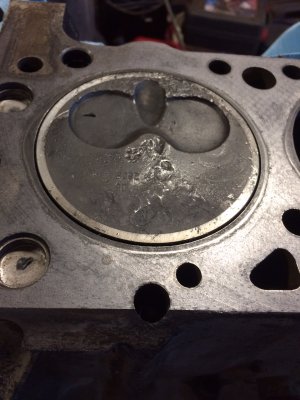
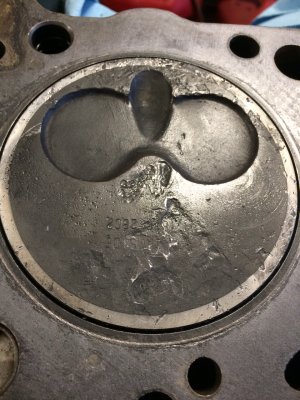
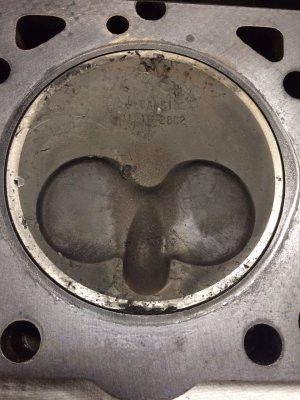
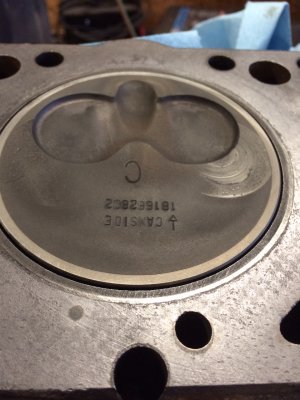
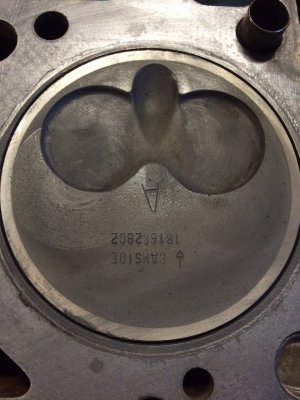
What are the thickest head gaskets available? Got my heads off now for a valve job and there's valve kisses on many of the pistons. Engine is an unopened 173K motor as far as I know.

Just looking for a few extra thousandths!

Thanks
 

Waystro

No Class
Joined
May 11, 2014
Posts
2,595
Reaction score
37
Location
South Texas
What are the thickest head gaskets available? Got my heads off now for a valve job and there's valve kisses on many of the pistons. Engine is an unopened 173K motor as far as I know.

Just looking for a few extra thousandths!

Thanks
Could you please take lots of pics of the valve job etc?
I'll be doing the same soon
 

PwrSmoke

Full Access Member
Joined
Jan 2, 2007
Posts
807
Reaction score
23
Location
Northwest Ohio
You had best be determining the cause for this. If the valves are indeed tapping the piston, this engine has been apart before and either there is too much piston protrusion (block was decked too much in the past) and/or the heads have been milled to much or the valve recession was incorrectly set.

Head gaskets may vary somewhat in thickness by era and brand and I know of no complete source of information about all of them. There are no extra thick gaskets I know of. When I overhauled my 6.9L a few years back, I measured the compressed thickness of some mid '90s FelPro gaskets at 0.064" and the new ones I installed were 0.079" uncompressed. AERA uses a 0.062 +/- 0.002" as a base spec for all gaskets, so my measurement fell right in line with that.

Minimum Head thickness should be 4.7950 according to the book and new thickness is up to 4.8050". You can cut more than spec. Many of us, including me, have done so. As long as the valve recession is correct at 0.042-0.054 intake/0.046-058 exhaust, the valves should clear with a stock lift cam. Basically cut as little as possible and do both heads the same. What is the upper limit? Don't know, won't speculate. Just make sure the recession is correctly set!

Piston protrusion is listed at 0.010-0.031" in the factory manual but AERA lists a maximum of 0.055". They say the average factory spec as measured by teardown techs on unmolested engines is 0.020-0.035". Federal Mogul sells pistons that are decompressed 0.010" (pin moved up that much on piston to bring piston crown down the same amount) or you can have a few thou taken off the piston.
 

typ4

Full Access Member
Joined
Dec 24, 2005
Posts
9,131
Reaction score
1,431
Location
Newberg,OR
the other cause for this is the oil pressure relief sticking on cold starts , or we had a guy at Evergreen that would fire up. drop in gear and take off, just that fast, pumped the lifters for some reason and did the same thing. Very weak valve springs also may be a factor.
 

icanfixall

Official GMM hand model
Joined
Apr 10, 2005
Posts
25,858
Reaction score
682
Location
West coast
I believe Felpro head gaskets are the thickest. Then Victor Reinz. As already posted. Be absolutely sure the head thickness and especially the valve recession into the seats is correct. There is a minimum dimension from the top of th cylinder block to the center line of the crank too. Thats 11.137 to 11.141. For most that's not possible to measure. What you need to do is build a dummy crank and measure down to it from the top of the block. Then know what the dummy crank diameter is and divide by 2. Add that amount to the dimension measured. A lot of work really. I ran my first rebuild at 54 thousands piston protrusion without any issues. I do not recommend this. The oem factory piston make Mahle makes a low compression piston too.
 

jhenegh

Truck Still Earns its Keep
Joined
Jul 7, 2013
Posts
1,072
Reaction score
37
Location
Deerfield, WI
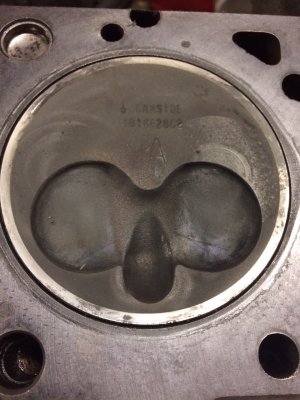
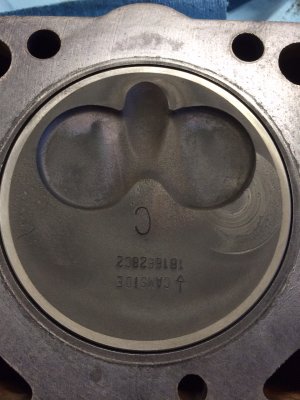
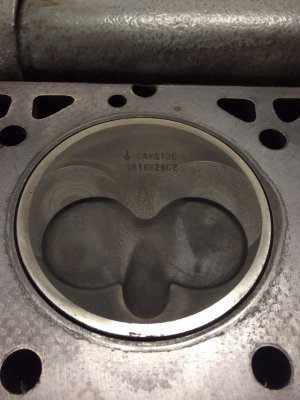
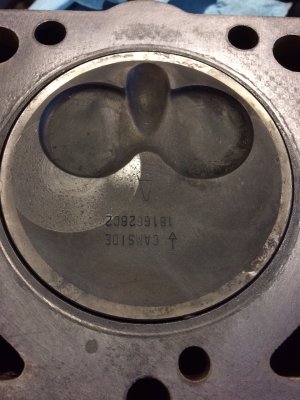
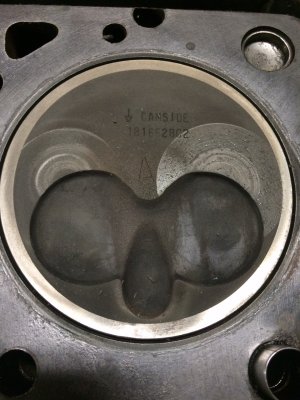
I see now she's been open before. Looks like it has eaten 2 glow plugs in the past? #6 and #7 have some piston top damage. edit: piston/cylinder number is the name of the picture. They're numbered 1-8

#2 is the cylinder where I was getting air back through the intake on a leakdown test. It also has the biggest valve imprints.

Somebody did some poor head work before??
 

Attachments

  • #8.JPG
    #8.JPG
    411 KB · Views: 43
  • #7.1.JPG
    #7.1.JPG
    390.3 KB · Views: 43
  • #7.JPG
    #7.JPG
    517.5 KB · Views: 41
  • #6.JPG
    #6.JPG
    469.5 KB · Views: 35
  • #5.1.JPG
    #5.1.JPG
    391 KB · Views: 35
  • #5.JPG
    #5.JPG
    435.6 KB · Views: 36
  • #4.JPG
    #4.JPG
    366.8 KB · Views: 32
  • #3.JPG
    #3.JPG
    432.5 KB · Views: 32
  • #2.JPG
    #2.JPG
    453.4 KB · Views: 36
  • #1.JPG
    #1.JPG
    429.7 KB · Views: 33
Last edited:

typ4

Full Access Member
Joined
Dec 24, 2005
Posts
9,131
Reaction score
1,431
Location
Newberg,OR
Its possible somebody used new thicker margin valves. Overrevving? many possibles
 

jhenegh

Truck Still Earns its Keep
Joined
Jul 7, 2013
Posts
1,072
Reaction score
37
Location
Deerfield, WI
You had best be determining the cause for this. If the valves are indeed tapping the piston, this engine has been apart before and either there is too much piston protrusion (block was decked too much in the past) and/or the heads have been milled to much or the valve recession was incorrectly set.

Head gaskets may vary somewhat in thickness by era and brand and I know of no complete source of information about all of them. There are no extra thick gaskets I know of. When I overhauled my 6.9L a few years back, I measured the compressed thickness of some mid '90s FelPro gaskets at 0.064" and the new ones I installed were 0.079" uncompressed. AERA uses a 0.062 +/- 0.002" as a base spec for all gaskets, so my measurement fell right in line with that.

Minimum Head thickness should be 4.7950 according to the book and new thickness is up to 4.8050". You can cut more than spec. Many of us, including me, have done so. As long as the valve recession is correct at 0.042-0.054 intake/0.046-058 exhaust, the valves should clear with a stock lift cam. Basically cut as little as possible and do both heads the same. What is the upper limit? Don't know, won't speculate. Just make sure the recession is correctly set!

Piston protrusion is listed at 0.010-0.031" in the factory manual but AERA lists a maximum of 0.055". They say the average factory spec as measured by teardown techs on unmolested engines is 0.020-0.035". Federal Mogul sells pistons that are decompressed 0.010" (pin moved up that much on piston to bring piston crown down the same amount) or you can have a few thou taken off the piston.


I gave these numbers and those pictures to the machinist this morning. We'll see what he finds. Hope those are the right ones!
 

PwrSmoke

Full Access Member
Joined
Jan 2, 2007
Posts
807
Reaction score
23
Location
Northwest Ohio
They are and were sourced from the AERA (Automotive Engine Rebuilders Association) bulletins on the 6.9-7.3L engines, or from factory manuals. Machine shops are usually AERA members, so he should have access to the AERA database for confirmation.

The only part that's "off the reservation" is head thickness. AERA still (last I checked) sticks with the factory head thickness number. Many of us here, and machinists, have long gone farther... judiciously. I'm about 0.012 under that spec now and icanfixall is running a couple of engines in the same ballpark, as is, I think, typ4. If the valve recession specs are set right (at the deep end the more you are worried) and piston protrusion isn't excessive, it seems to work. I was so paranoid during my overhaul that I installed the new heads (with light test valve springs installed) with shims that mimicked compressed head gasket thickness. I install clay on the piston tops under the valves to measure how close the valves got to the piston and rolled the engine thru several revolutions. Plenty of clearance in my case. The light valve springs eliminated the possibility of the springs compressing the lifters. In fact, the light springs probably simulated a worst case where the lifter might be pumped up past their preload position by excess oil pressure).

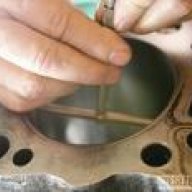
I don't know if the machinist has just the heads or the whole engine, but if he has just the heads, make sure you check piston protrusion. That's an important part of the equation and if you have a lot, it will effect what the machinist can and will do to the head. Here's a pic of when I checked my engine during a test assembly.

attachment.php


I used the dial indicator to make sure the piston was at TDC then used the depth gauge to measure protrusion. Again, it was 0.016" on my engine, which was very much a relief.

 

BDCarrillo

Full Access Member
Joined
Jul 19, 2014
Posts
1,245
Reaction score
10
Location
Abilene TX
I tore apart a knocker engine that had valve kisses all over. The rod bearings were loose enough to let each piston go high enough to tap the valve.

Since you have a chewed up piston already, might as well refresh the rotating assembly
 

PwrSmoke

Full Access Member
Joined
Jan 2, 2007
Posts
807
Reaction score
23
Location
Northwest Ohio
I tore apart a knocker engine that had valve kisses all over. The rod bearings were loose enough to let each piston go high enough to tap the valve.

Since you have a chewed up piston already, might as well refresh the rotating assembly

Something to consider! The tolerances would have to be pretty close already, perhaps via previous machine work or tolerance-stacking at the factory, for 0.002-.003 extra rod bearing clearance to get the valves and pistons kissing. Still, it's the kinda off-the-wall thing that could bite one in the butt.
 

Forum statistics

Threads
93,001
Posts
1,155,994
Members
26,589
Latest member
tke395

Members online

Top