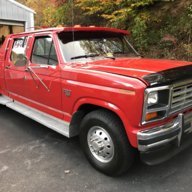
I need an engine!

GRY9273IDI

Registered User
Joined
May 26, 2025
Posts
34
Reaction score
4
Location
florida
IDIBRONCO, you are pretty close. Liner typically refers to the cylinder liner that is used on "wet" liner engines. They have O-ring grooves and seal against the block using O-rings and brass shims. Liner height or protrusion is critical, as the clamp load from the cylinder head holds the liner in place. During an overhaul, these liners are removed and replaced, the engine is never bored to a larger piston size. Often the sealing surfaces of the block will still need to be re-machined to clean it up. There are over sized shims available just for this reason. See Image of a wet liner below. Most large displacement diesels are wet liner engines. The smallest wet liner engines that I am aware of is International's 400 engine family, (DT466 and it's variants) and the 53 Series Detroits.

A dry liner, or sleeve, is used on all parent bore blocks to repair a cylinder that has been damaged beyond what can be removed by a standard overbore. In this situation, the bore is machined out far enough to accept the sleeve. The sleeve is than pressed into the bore and then machined to final bore size and surface finish. Nearly all light duty engines (including our IDI's) are parent bore blocks.

That said, alot of machinists will interchange the use of liner and sleeve, so don't get hung up on the nomenclature. Typically most machine shops will charge $80 to $125 per hole to sleeve a block.

You must be registered for see images attach
Does that mean that sleeping is a cure all for cavitation? Or can cavitation still occur after the cylinders have been sleeved and should the coolant additive still be used?
 

DirtyWood

Full Access Member
Joined
Apr 20, 2025
Posts
303
Reaction score
186
Location
Earth
Coolant with proper SCA package seems a lot cheaper than sleeving the block. Every time I read how much it cost to sleeve all 8 it just didn't seem worth it.
 

FrozenMerc

Full Access Member
Joined
Dec 21, 2018
Posts
455
Reaction score
786
Location
SW Missouri
Cavitation damage occurs any time that a bubble within a fluid implodes next to or against a solid surface. It can occur anytime the right conditions exist. The 7.3 is more susceptible to cavitation than the 6.9 because the cylinder walls are thinner, and therefore they move (or vibrate) more during engine operation. The increased motion (and I am talking about a few ten-thousandths of an inch here) causes the cylinder wall to rapidly pull away from bubbles that are forming due to the localized boiling of the coolant. As the wall pulls away, it causes the bubble to implode and "pull" a small amount of of the cylinder wall material away with it. Sleeving a 7.3 back to stock bore does not change this fact. This is why SCA's are used. SCA's change the fluid properties of the coolant such that it becomes much more difficult for bubbles to form and implode in the fluids boundary layer next to the cylinder wall.

Here is an image of a liner from a large Cummins (wet liner type engine) with cavitation damage on the outside of the liner. That liner is probably 3/8" thick or better in that area. Much heavier than the cylinder wall in an IDI.

You must be registered for see images attach
 

GRY9273IDI

Registered User
Joined
May 26, 2025
Posts
34
Reaction score
4
Location
florida
Coolant with proper SCA package seems a lot cheaper than sleeving the block. Every time I read how much it cost to sleeve all 8 it just didn't seem worth it.
I have a 7.3 that is sleeved already. It needs new pistons and heads but the block is good. I am just unsure of whether or not the sleeves eliminate the possibility of cavitation in the future or if the coolant still needs SCAs.
 

Forum statistics

Threads
92,929
Posts
1,155,108
Members
26,430
Latest member
Brownlee5212

Members online

Top