
You are using an out of date browser. It may not display this or other websites correctly.
You should upgrade or use an alternative browser.
You should upgrade or use an alternative browser.
Balancing engine internals
- Thread starter lbzbuick
- Start date
icanfixall
Official GMM hand model
To balance engine internals the shop needs everything that spins in the engine. Thats rods with bearings, pistons complete with pins and rings, Crank but not the crank bearings because they don't spin. Flywheel or flrxplate and the front dampner.
Blueprinting an engine brings back all the demensions to exacting standards. Any engine is machined to a factory tollerance. This means its not really correct but its "close enough" to work. Mostly the cylinders are not bored exactly square with the crank. When you remove a piston look at the bearing. If it shows wear more on one side or the other its not square with the crank. The main bearings generally will show the same wear pattern because the main web bearing saddles are "close but not close engoug" but it runs. All this wear creates internal drag that takes away you hp and mileage. My engine is balanced much more than it needed to be but... I hear my engine running but can't actually feel it running. When I was having the balance work done the pistons were way out of spec. There was such a differanc in piston to piston weights the shop couldn't take enough material off to even get them close. So talking with an Engineer at Mahle about this he told me not to worry because they engineered the pistons to run fine even if the differance in weights were as high as 14 grams... These engines don't turn high rpms so its just fine.... Nope.. Not for me. So they got back the set I had and finally they sent me a set that was much better on weights between eash piston. I then balanced them myself with a gram scale that could tell meweights down to a 10th of a gram. The shop ground the big and small ends of the rod. Drilled and welded the crank... That was so far off from the first fools that balanced it for me... I think it was 43 grams light in the center mid plain balance. The dampner was drilled and the flexplate was drilled. Its then assembled with a weight called a bob weight. Each rod with bearing and complete pistons weight is added to the crank and then its spun up and the balance computer tells the person what and where the drilling or addition of weight has to be done. Sometimes you need to add a special metal to the crank because you don't have enough room for normal weight material. Its called heavy metal. When I was working in the power generation shop for a major utility company we would balance steam turbine rotors that weighed as much as 80 tons. Mostly it was around 20 to 60 tons done in the shop but the equiptment was taken to the sites too. We would get the balance as close as 2 ozs on all the toros. You should have seen these rotors with a diameter of 17 feet spinning up around 500rpm... They actually sucked in lots of air so you had to be sure nothing was blowing around like a news paper. It was an exciting part of my job but not something you felt terrified of either.
Blueprinting an engine brings back all the demensions to exacting standards. Any engine is machined to a factory tollerance. This means its not really correct but its "close enough" to work. Mostly the cylinders are not bored exactly square with the crank. When you remove a piston look at the bearing. If it shows wear more on one side or the other its not square with the crank. The main bearings generally will show the same wear pattern because the main web bearing saddles are "close but not close engoug" but it runs. All this wear creates internal drag that takes away you hp and mileage. My engine is balanced much more than it needed to be but... I hear my engine running but can't actually feel it running. When I was having the balance work done the pistons were way out of spec. There was such a differanc in piston to piston weights the shop couldn't take enough material off to even get them close. So talking with an Engineer at Mahle about this he told me not to worry because they engineered the pistons to run fine even if the differance in weights were as high as 14 grams...
These engines don't turn high rpms so its just fine.... Nope.. Not for me. So they got back the set I had and finally they sent me a set that was much better on weights between eash piston. I then balanced them myself with a gram scale that could tell meweights down to a 10th of a gram. The shop ground the big and small ends of the rod. Drilled and welded the crank... That was so far off from the first fools that balanced it for me... I think it was 43 grams light in the center mid plain balance. The dampner was drilled and the flexplate was drilled. Its then assembled with a weight called a bob weight. Each rod with bearing and complete pistons weight is added to the crank and then its spun up and the balance computer tells the person what and where the drilling or addition of weight has to be done. Sometimes you need to add a special metal to the crank because you don't have enough room for normal weight material. Its called heavy metal. When I was working in the power generation shop for a major utility company we would balance steam turbine rotors that weighed as much as 80 tons. Mostly it was around 20 to 60 tons done in the shop but the equiptment was taken to the sites too. We would get the balance as close as 2 ozs on all the toros. You should have seen these rotors with a diameter of 17 feet spinning up around 500rpm... They actually sucked in lots of air so you had to be sure nothing was blowing around like a news paper. It was an exciting part of my job but not something you felt terrified of either.
Dave Barbieri
Full Access Member
Balancing is a great win/win situation. The money you invest gets paid back in terms of longer engine life and greater engine efficiency. That means more power and better fuel mileage. You get to have your cake and eat it too. Balancing the moving pieces/parts mean that they move equally in and out, round and round. No one part is heavier and causing vibration and stress. (Longer engine life) It also means that you don't sacrifice power to lost motion - parts fighting against each other because they're not equal. (Better efficiency)
Balancing makes each part equal in weight to its buddies. How this is accomplished depends on the part:
Crankshaft: Weight can be removed or added to the counterweights. Removed by drilling; added by drilling and filling with heavy metal. The harmonic balancer and the flywheel/flexplate are usually balanced as a group with he crank. If you have a manual trans, this will also include the pressure plate.
Rods: Balanced to the lightest rod in the group. Weight is removed by grinding material off the top and/or bottom of the rod. The goal here is to make the rods equal in weight and to also balance them top to bottom. Sorta like a throwing knife.
Pistons: Like the rods, they're also balanced to the lightest guy in the group. This also takes into account the weight of the rings. You'll be asked to bring one set with the pistons. Weight is removed by removing metal from the bottom of the piston pin bushing, and sometimes from the underside of the crown.
The actual cost is determined by how close to '0 balance' you go. Your machinist will give you a range of weight and cost. My machinist balances to within 1 gram and charges $225 for a V-8 engine. A gram is equal to about half a sheet of notebook paper. That's pretty close! Done well by someone that knows their craft, you end up with a motor that's noticeably smoother throughout its entire RPM range. Your butt-dyno and your wallet will also notice the difference!
Blueprinting is using machine procedures to make the pieces/parts dimensionally exactly like the engineers designed them. No tolerances, no slop, everything fits perfectly and functions as dreamed. On the extreme side, blueprinting involves every piece of the engine. From an affordable point, you're mostly interested in the cylinder bores being parallel with each other and perpendicular to the crank (Align bore). You want to make sure that the crankshaft bores are all aligned and perfectly straight (align bore). You'll also want the block surface to be exactly perpendicular to the bores, parallel to the crank and perfectly even (decking). Cylinder heads get the same surface treatment.
Balancing makes each part equal in weight to its buddies. How this is accomplished depends on the part:
Crankshaft: Weight can be removed or added to the counterweights. Removed by drilling; added by drilling and filling with heavy metal. The harmonic balancer and the flywheel/flexplate are usually balanced as a group with he crank. If you have a manual trans, this will also include the pressure plate.
Rods: Balanced to the lightest rod in the group. Weight is removed by grinding material off the top and/or bottom of the rod. The goal here is to make the rods equal in weight and to also balance them top to bottom. Sorta like a throwing knife.
Pistons: Like the rods, they're also balanced to the lightest guy in the group. This also takes into account the weight of the rings. You'll be asked to bring one set with the pistons. Weight is removed by removing metal from the bottom of the piston pin bushing, and sometimes from the underside of the crown.
The actual cost is determined by how close to '0 balance' you go. Your machinist will give you a range of weight and cost. My machinist balances to within 1 gram and charges $225 for a V-8 engine. A gram is equal to about half a sheet of notebook paper. That's pretty close! Done well by someone that knows their craft, you end up with a motor that's noticeably smoother throughout its entire RPM range. Your butt-dyno and your wallet will also notice the difference!
Blueprinting is using machine procedures to make the pieces/parts dimensionally exactly like the engineers designed them. No tolerances, no slop, everything fits perfectly and functions as dreamed. On the extreme side, blueprinting involves every piece of the engine. From an affordable point, you're mostly interested in the cylinder bores being parallel with each other and perpendicular to the crank (Align bore). You want to make sure that the crankshaft bores are all aligned and perfectly straight (align bore). You'll also want the block surface to be exactly perpendicular to the bores, parallel to the crank and perfectly even (decking). Cylinder heads get the same surface treatment.

OLDBULL8
Good Morning Ya'll.
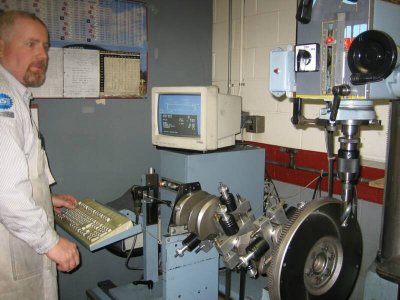
This is one of the balancing machines, called a dynamic balancer where the crank is spun. You can see the "bob weights" fastened to the crank, they take the place of the rods and pistons. If you have a postal scale, you can weigh and compare the assembled rod, bearings and piston with each other. That way it's not exactly within grams, but it gives you an idea of how close to each other they are.
Attachments
This one is a pet peave of mine left over from running a machine shop a few decades ago, . Right on all counts on the balancing, but Blueprinting is a term that gets thrown around all over the place and nobody who uses it has a clue as to what it means. It simply means that the engine is built to a pre designated set of design specs all the way through instead of being thrown together willy nilly as you go along making changes along the way as you see fit.
In this manner, all factory engines are blueprinted.
It used to drive me nuts when all the kids would come in to teh shop, contents of piggy bank in hand, and tell me they wanted their camero engine built up "balanced and blueprinted" to which I would respond, OK where are your design specifications...... instant deer in the headlights. At that point I'd sit them down and afterthey realized that their buddy was an idiot, we'd figure out what they could realistically build with the budget they had, hopefully talking them into something that would last in the process, instead of just something that was fast.
In this manner, all factory engines are blueprinted.
It used to drive me nuts when all the kids would come in to teh shop, contents of piggy bank in hand, and tell me they wanted their camero engine built up "balanced and blueprinted" to which I would respond, OK where are your design specifications...... instant deer in the headlights. At that point I'd sit them down and afterthey realized that their buddy was an idiot, we'd figure out what they could realistically build with the budget they had, hopefully talking them into something that would last in the process, instead of just something that was fast.

hesutton
The Anti-Anderson
Very good descriptions above. I just had my rotating assembly balanced for my 6.9 rebuild. It's not done, so I can't give you any feedback, but, I have heard it makes a huge difference.
You'll need everything that spins with the crank:
Crank
Rods
Pistons (with rings, pins, clips)
Harmonic balancer
Flywheel/Flexplate
Interestingly, my SMF for South Bend Clutch was was off balance. They corrected that for me as well. Cost was $220 prior to adding the flywheel mods. That was another $50. Pulling it on and off the crank is a PITA and thus the extra cash.
Heath
You'll need everything that spins with the crank:
Crank
Rods
Pistons (with rings, pins, clips)
Harmonic balancer
Flywheel/Flexplate
Interestingly, my SMF for South Bend Clutch was was off balance. They corrected that for me as well. Cost was $220 prior to adding the flywheel mods. That was another $50. Pulling it on and off the crank is a PITA and thus the extra cash.
Heath
thanks guys for the info. What harmonic balancers are you running? like fluidampner?
If you can talk fluidcampner or anyone else into making a high end balancer for our engines, by all means, please do
 but as it stands, you have two options, IH dealer and Ford dealer
icanfixall
Official GMM hand model
Actually there is a third option... Ebay has them listed sometimes. The seller I paid $99.00 for mine was located in Texas... It was new in a ford box and free shipping too...
Dave Barbieri
Full Access Member
Do you have the guy's name? There are 'new' HD's listed for $99.99, but the ad sez "New aftermarket harmonic balancer." If it's truly a brand new OEM setup, I'm interested!Actually there is a third option... Ebay has them listed sometimes. The seller I paid $99.00 for mine was located in Texas... It was new in a ford box and free shipping too...
hesutton
The Anti-Anderson
If you can talk fluidcampner or anyone else into making a high end balancer for our engines, by all means, please do
Robert's right. No aftermarket dampers. And, there will likely never be any. Not much new in the aftermarket for a 25 year old engine platform.
Heath
icanfixall
Official GMM hand model
I can't find the seller on ebay at this time. The dampner I have is new oem part number printed on the ford box is E3TZ-6316-A... I will do some looking...
icanfixall
Official GMM hand model
Ford still sells oil pans but ebay sells them cheaper either new or aftermarket...
Dave Barbieri
Full Access Member
The vendor is Specialty Engine Parts here in Texas. I emailed him and asked who the manufacturer was. Here's the response:I can't find the seller on ebay at this time. The dampner I have is new oem part number printed on the ford box is E3TZ-6316-A... I will do some looking...
Dear 91jetta1.9td,
This is a Ford OEM surplus balancer.
- specialtyengineparts
I bought one!
Similar threads

- Replies
- 41
- Views
- 5K


- Replies
- 21
- Views
- 2K


