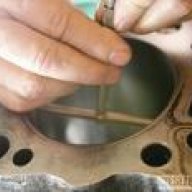
random thought about Ceramic coating

IDIoit

MachinistFabricator
Joined
Aug 26, 2014
Posts
13,438
Reaction score
4,186
Location
commiefornia
we always see pistons getting ceramic coated.

true that the aluminum has a lower melting point than iron.

why dont we ceramic coat the valves and combustion chamber also?

theoretically makes sense to me since this is where most of the heat is generated..

what are your thoughts?
 

icanfixall

Official GMM hand model
Joined
Apr 10, 2005
Posts
25,858
Reaction score
681
Location
West coast
In any kink of racing or performance engines I have never read if a valve can or was ceramic coated and lived. My thoughts about coating the precups is a bad idea. Now if you were to ceramic coat the head end of the cup area that might prevent some heat from entering the coolant system.
 

laserjock

Almost there...
Joined
Nov 20, 2012
Posts
8,851
Reaction score
3,142
Location
Maryland
I've had too beefs with performance engines that nobody has ever really been able to explain to me. 1 is ceramic coating. The other is cryo-treatment.

With ceramic coatings everyone "says" that it shields the heat from the parts. While in principle I agree fully that ceramic makes a great heat shield because it can be a poor conductor of heat, I have a hard time believing that a few microns of ceramic on an aluminum piston makes any real measurable difference. We can break out the thermodynamics books but I'm sorry ceramic is not magic especially at those thicknesses. You are barely filling the machine tool marks, if that, hence why you don't have to really make allowances for the coating. Besides, unless you are drag racing, the pistons are going to heat soak to equilibrium anyway in what I suspect is very short order.

Second, cryo treating. People say that it allows the metal to rearrange. Unless you allow the metal to undergo a change in crystal structure, I don't buy it. Phase diagrams don't lie. Steel typically has to be heated to undergo a phase change. The only thing dropping it in liquid nitrogen is doing is causing it to shrink. But warming back to room temperature without some type of heat sequence like you would get from heat treating is doing nothing. You have to overcome the activation energy of the crystal structure to change forms and nobody has been able to explain to me what the cryo treatment actually does. They just say it works.

If someone can explain to me with science how these things work I'm all ears but just waving hands and saying it works doesn't cut it for me.

Sorry, rant over. I'll go back to sleep now.
 

dunk

Dunce
Joined
Oct 25, 2013
Posts
991
Reaction score
4
Location
NJ
From a coating company: http://techlinecoatings.com/articles/Coating_CylHead_Article.htm

Makes sense that coating combustion chambers may increase detonation resistance and heat load on cooling system. I polish combustion chambers on my builds as extra insurance against detonation.

Coating the valve, I assume you mean combustion chamber side of head, should reduce valve operating temp. I know of some valves (motorcycles) with anti friction coating on the stem... But reports after teardown is the coating wears and flakes away causing issues with valve guide wear and clearance. Interesting thought, but probably not worth much power. Thermal barrier coating on pistons is probably about it for what makes sense in an IDI, given high EGT and piston melting concerns.

Hot rod article on coatings. On a 551 HP build coatings added 8 HP. http://www.hotrod.com/how-to/engine/hrdp-0612-engine-coatings/
 

ps444mike

Registered User
Joined
Oct 11, 2014
Posts
54
Reaction score
3
Location
Southern Calif
not sure..myself.. I did get lots of parts freezed on my 97 powerstroke build up an installed a set of these..

Hypermax High Temperature Inconnel Exhaust Valves
Inconel valves specially engineered to withstand the increase temperatures.
 

icanfixall

Official GMM hand model
Joined
Apr 10, 2005
Posts
25,858
Reaction score
681
Location
West coast
Inconel will rersist heat very well plus it has a high resistance to abrasion. I used to tig weld it in the power generation machine shop where the extreme high pressure steam (4200 lbs @ 1050 degrees) would cut the diaphragms and case halves.
 

mu2bdriver

Full Access Member
Joined
Jan 26, 2014
Posts
757
Reaction score
173
Location
CT
I have no idea about the science of why or how it's so, but in aircraft engines, specifically the TFE series of engine, ceramic-coated parts have significantly higher heat tolerances (via higher ITT temperatures) than their non-ceramic'ed siblings. Redline ITT is something about 30-40 degrees C higher.
 

jaluhn83

Full Access Member
Joined
May 19, 2012
Posts
1,597
Reaction score
49
Location
Upper Marlboro, MD
we always see pistons getting ceramic coated.

true that the aluminum has a lower melting point than iron.

why dont we ceramic coat the valves and combustion chamber also?

theoretically makes sense to me since this is where most of the heat is generated..

what are your thoughts?

Not an expert, my my thoughts are that it's technically more difficult and isn't going to give much benefit. The piston is typically the critical part since it has no direct contact with the coolant and a substantial thickness of material for structural reasons, plus a large exposed surface area. What this means is that you have a large amount of heat entering from the surface, and it must travel out either through oil cooling of the bottom or through the skirt and hence the cylinder walls. Both of these are fairly long paths with significant resistance. This is why the piston is typically aluminum and also results in the piston crown typically being the hottest part in the engine. The combustion chamber however has a fairly thin shell with coolant directly on the other side - it's going to have a much easier time shedding heat, and consequently generally isn't going to get as hot. Valves can be an issue because they have a similar problem to the pistons - limited heat flow out, but they are also typically of material that can handle higher temps and smaller.

Consequently, while coating the valve faces (not the entire valve, the seating area must have good metal to metal contact for heat conduction) could help, I don't think there's really a need to do so - how often do you see valves that overheated from excess heat load? IIRC most burnt valves result from poor seat contact, hence inability to shed heat and poor sealing leading to a gas jet that causes physical erosion, not actual overheating. The cylinder head in general also doesn't really benefit - already has a good cooling path, so temps are not critical.

I also suspect that getting a smooth consistent coating on a complex surface like a combustion chamber is going to be difficult.
 

jaluhn83

Full Access Member
Joined
May 19, 2012
Posts
1,597
Reaction score
49
Location
Upper Marlboro, MD
I've had too beefs with performance engines that nobody has ever really been able to explain to me. 1 is ceramic coating. The other is cryo-treatment.

With ceramic coatings everyone "says" that it shields the heat from the parts. While in principle I agree fully that ceramic makes a great heat shield because it can be a poor conductor of heat, I have a hard time believing that a few microns of ceramic on an aluminum piston makes any real measurable difference. We can break out the thermodynamics books but I'm sorry ceramic is not magic especially at those thicknesses. You are barely filling the machine tool marks, if that, hence why you don't have to really make allowances for the coating. Besides, unless you are drag racing, the pistons are going to heat soak to equilibrium anyway in what I suspect is very short order.

Second, cryo treating. People say that it allows the metal to rearrange. Unless you allow the metal to undergo a change in crystal structure, I don't buy it. Phase diagrams don't lie. Steel typically has to be heated to undergo a phase change. The only thing dropping it in liquid nitrogen is doing is causing it to shrink. But warming back to room temperature without some type of heat sequence like you would get from heat treating is doing nothing. You have to overcome the activation energy of the crystal structure to change forms and nobody has been able to explain to me what the cryo treatment actually does. They just say it works.

If someone can explain to me with science how these things work I'm all ears but just waving hands and saying it works doesn't cut it for me.

Sorry, rant over. I'll go back to sleep now.

Ceramic coating does make sense. The overall heat flow through a piston can be broken up into a series of discreet heat transfer events - convection from hot combustion gasses to piston; conduction through the piston; potentially conduction through piston/cylinder interface and hence through cylinder wall; convection to oil/coolant. In each case, the amount of heat transferred is a function of the effective resistance (a function of the material/boundary properties) and the temperature differential. The final heat sink is the coolant/oil, and the temperature of this is largely fixed. The resistances through the system are also largely fixed, so for a given hot side temperature, a certain distribution of temperature through the system is reached due to the balance of heat flow/temperature. All of the heat that goes in must ultimately be rejected to the coolant/oil, and the temperature at each point comes from the need to have enough temperature difference to move that amount of heat to the next section of the system. The overall amount of heat that enters the system is then a function of the total resistance between the heat source (combustion gas) and heat sink (coolant/oil) and the total resistance of the system.

While the ceramic coating is quite thin, it has a very high thermal resistance. Adding this does 2 things. First, it add significantly to the overall system resistance, which decreases the overall heat flow through the system. More importantly however it adds a relatively large resistance between the heat source and the rest of the system. What this does is lowers the temperature of the rest of the system since all those resistances stay the same, hence a lower temperature differential is required across each other item to move the now reduced amount of heat. Since the heat sink temperature is the same, this means the individual parts now run cooler.

Tooling marks are on under 0.001" - coating is typically 0.005" - more than fills tool marks.

Cryo treatment could be useful is conducted as part of a quench cycle since quenching to lower temps will increase the quench rate which plays a part in the micro structure.... but I don't see any benefit to throwing a chunk of steel in LN. Even if it is part of a quench treatment, this would have to be engineered correctly to get a decent result - could very well make the part less useful due to brittleness.
 

Fixnstuff

Full Access Member
Joined
Sep 28, 2015
Posts
213
Reaction score
69
Location
Kitsap County, Washington
...

While the ceramic coating is quite thin, it has a very high thermal resistance. Adding this does 2 things. First, it add significantly to the overall system resistance, which decreases the overall heat flow through the system. More importantly however it adds a relatively large resistance between the heat source and the rest of the system. What this does is lowers the temperature of the rest of the system since all those resistances stay the same, hence a lower temperature differential is required across each other item to move the now reduced amount of heat. Since the heat sink temperature is the same, this means the individual parts now run cooler....

You missed some of the most important benefits of ceramic coatings on surfaces inside the combustion chamber. (including heads and valves- I'll post a study on that shortly).

When the transfer of heat through combustion chamber surfaces is reduced by ceramic coatings, where does that additional heat in the combustion chamber go? It increases the temperature of the combustion of the fuel/air mixture. That higher temperature results in more efficient combustion which results in more power, better fuel economy and substantially less pollution in the exhaust. These higher temperature gasses are exhausted through the exhaust system raising exhaust gas temperatures (EGTs) but that is not a bad thing - It's not what higher EGTs mean in a non-treated engine. With these higher EGTs the engine is actually running cooler while the combustion process is hotter.

Cryo treatment could be useful if conducted as part of a quench cycle since quenching to lower temps will increase the quench rate which plays a part in the micro structure.... but I don't see any benefit to throwing a chunk of steel in LN. Even if it is part of a quench treatment, this would have to be engineered correctly to get a decent result - could very well make the part less useful due to brittleness.

I've been fascinated with metals since about 1967-1970 when I first learned that metals are crystals, eg, crystalline with a lattice structure (arrangement of atoms). Later I studied welding metallurgy and the grain structure of steels and various treatments to alter the grain structure to provide improved characteristics was a big part of that. That was in the late 1970s.
Cryogenic treatments were known, I read little bit about it- probably studies published in trade journals or abstracts but not much information about it back then.

When I looked at cryogenic treatments yesterday (for steel) I recognised the terminology and structure changes. Essentially the same stuff I learned long ago. This is in the realm of advanced metallurgy and not easy for someone who has not studied it to understand.
Reading less complex magazine or journal articles about it is an easier, quicker way.

However, the processes are not so complicated so if a person knows the details of a tried and proven process I think it could be easily done in your back yard or garage.

From what little I have read about cryogenic treatment of steels I don't recall seeing brittleness as a concern, but I could be mistaken.

For many reasons I don't have the time, energy or convenience to study this to provide more information.
 

laserjock

Almost there...
Joined
Nov 20, 2012
Posts
8,851
Reaction score
3,142
Location
Maryland
You missed some of the most important benefits of ceramic coatings on surfaces inside the combustion chamber. (including heads and valves- I'll post a study on that shortly).

When the transfer of heat through combustion chamber surfaces is reduced by ceramic coatings, where does that additional heat in the combustion chamber go? It increases the temperature of the combustion of the fuel/air mixture. That higher temperature results in more efficient combustion which results in more power, better fuel economy and substantially less pollution in the exhaust. These higher temperature gasses are exhausted through the exhaust system raising exhaust gas temperatures (EGTs) but that is not a bad thing - It's not what higher EGTs mean in a non-treated engine. With these higher EGTs the engine is actually running cooler while the combustion process is hotter.


I've been fascinated with metals since about 1967-1970 when I first learned that metals are crystals, eg, crystalline with a lattice structure (arrangement of atoms). Later I studied welding metallurgy and the grain structure of steels and various treatments to alter the grain structure to provide improved characteristics was a big part of that. That was in the late 1970s.
Cryogenic treatments were known, I read little bit about it- probably studies published in trade journals or abstracts but not much information about it back then.

When I looked at cryogenic treatments yesterday (for steel) I recognised the terminology and structure changes. Essentially the same stuff I learned long ago. This is in the realm of advanced metallurgy and not easy for someone who has not studied it to understand.
Reading less complex magazine or journal articles about it is an easier, quicker way.

However, the processes are not so complicated so if a person knows the details of a tried and proven process I think it could be easily done in your back yard or garage.

From what little I have read about cryogenic treatment of steels I don't recall seeing brittleness as a concern, but I could be mistaken.

For many reasons I don't have the time, energy or convenience to study this to provide more information.

I would appreciate any thing you could point me to. I'm not a metallurgist but I do have a Ph.D. In chemistry and a materials background. Maybe I can follow along. [emoji15]

I'm not trying to start an argument, I'm just trying to educate myself with something more than as you put it magazine articles aimed at those not skilled in the art. I'm not even trying to say I'm right. Just looking to learn something and get facts out there for the general population.
 

Fixnstuff

Full Access Member
Joined
Sep 28, 2015
Posts
213
Reaction score
69
Location
Kitsap County, Washington
we always see pistons getting ceramic coated.

true that the aluminum has a lower melting point than iron.

why dont we ceramic coat the valves and combustion chamber also?

theoretically makes sense to me since this is where most of the heat is generated..

what are your thoughts?

The heat is 'generated' in the combustion process but I know what you meant.

Yes it makes a lot of sense along with the ceramic coatings on the surface of the head. I think we may see the coated valves soon.

I'm posting a link to an interesting study further below.

I started a long reply about this last night while also researching it further, left the computer on while I slept and finished it today. I hit the button to post it and a SNAFU in the forum software rejected it with a message containing something like, '.. logging in after logging in hit the backspace button. I did and my work was lost forever.

Anyhow, below is the url to a full text article published in an engineering journal June 2014.

Ceramic treated (piston, head and valves) diesel engine compared to an identical non-treated engine. It's a study that focuses on emissions but also shows increased power with reduced fuel consumption.

The results were surprising to me with substantial improvements in the treated engine on every measure. I was also impressed with how well the biodiesel fuels performed.

Read it carefully. The first long paragraph is the abstract and the rest of the document explains the entire study and what it means. On the 7th page (labelled 5) are the conclusions. It's an easy read to that point. The rest of the article to page 18 shows graphs, a few photos and over a page of reference citations to related research.

I only gave this article one quick read last night.

See my comment about the exhaust gas temperatures (EGTs) in the treated engine -> that comment is in my previous post.

Also, the graphs are simple to understand- just remember that better performance in the graphs is ALWAYS the ceramic treated engine- and the higher EGTs in the treated engine are a GOOD thing- you have to see my previous comment on that or you'll figure it out in the article.

I am not a professional mechanic, just a back yard mechanic with a technical background that allows me to at least understand a lot of this more advanced science and technology.

I suggest focusing on what the abbreviations are for. They are in the article but the translators could have done a better job of organizing that part.

Here is the list of the abbreviations used which appears later in the article:

NOMENCLATURE


CO - carbon monoxide


HC - hydrocarbons (ppm) (ppm = parts per million)


CO2 - carbon dioxide


B5 – 5:95 of biodiesel to diesel fuel mixing ratio


B10 – 10:90 of biodiesel to diesel fuel mixing ratio


B100 – 100% biodiesel


BSFC - brake specific fuel consumption


YSZ – yttria - stabilized zirconia


LHR - low heat rejection


SE - standard engine


KOH - potassium hydroxide


EGT - exhaust gas temperature


BTE - brake thermal efficiency


The Effect of Ceramic Coating on Performance and Emission of Diesel Engine Operated on Diesel Fuel and Biodiesel Blends
http://www.iasj.net/iasj?func=fulltext&aId=89557

I will not be surprised if ceramic coatings in engines (diesel engines in this case) become required by Law in the USA, based on the substantial improvements in emissions and better fuel economy.

 

laserjock

Almost there...
Joined
Nov 20, 2012
Posts
8,851
Reaction score
3,142
Location
Maryland
Okay, so I did a quick read. Here are a few observations. Please don't interpret this as a me trying to discredit or not being appreciative of your searching. Sometimes I come off that way when I'm trying to have a discussion.


So the data they show would seem to indicate that there are improvements, however; you will also notice there are no error bars on any of the graphs meaning that either they didn't take enough data to get statistics or they aren't showing it. Anytime you have data that follow a similar tend like many of these charts do, you really can't definitively tell much without error bars. Essentially, the error bars represent the range of experimental values likely to be observed based on statistical analysis. Fact of the matter is if the error bars are large enough to overlap, the results are statistically the same.

All that aside, I'm going to look up some of the references as they are probably sound and a good place to start a more in depth reading.

So again, thank you and I hope we can continue the discussion. I'll start digging in to the literature.

I'm going to drop some papers here. I haven't read them thoroughly but seem on point. Basically I'm dropping them here so I don't loose them. Feel free to browse.

http://www.iust.ac.ir/ijae/files/site1/user_files_62fop6/eng/hakim-A-10-63-33-2d1f698.pdf

http://citeseerx.ist.psu.edu/viewdoc/download?doi=10.1.1.413.9437&rep=rep1&type=pdf

http://waset.org/publications/14450...ocharged-low-heat-rejection-d.i-diesel-engine
 
Last edited:

bbjordan

Snow Monkey
Joined
Feb 24, 2011
Posts
1,427
Reaction score
399
Location
Ashern Manitoba
Good article! Is too bad they didn't play with the timing using the different fuels. I suspect there is more to be got from the bio-fuels by retarding the timing a little. I use somewhere between B5 and B20, depending on the season. I notice that it likes the timing a little retarded from the straight diesel setting. I suspect there is even more to be gotten from combo fuels: diesel & propane, diesel & HHO, WMO & propane, etc. But I'm getting way off topic now. :)

Sorry for the hijack.
 
Last edited:

Greg5OH

Full Access Member
Joined
May 14, 2011
Posts
2,373
Reaction score
42
Location
MI
huge replies but simply put you cannot ceramic coat a valve because there is no way to control the thickness, and will ahve an inconsitent pattern with the seat, not to mention it will crack due to the millions of repeated slaps on the seat. UNless we are talking just coating the face of it.. Combustion chamber is a different story, and theoreticaly its a good idea, in a practical approach with traditional powder coating, may be hard to to/keep it together. But a heat reflective coating on the CC woudl put more heat into the power stroke vs being absorbed by teh cooling jacket.. Same with the exhaust port, shoot it into the turbo rather than dissipate into the jacket

now jsut read the replies after posting mine, this is a nice thread! Hope to see more discussion, currently reading the articles. Staying tuned!
 
Last edited:

Forum statistics

Threads
92,932
Posts
1,155,156
Members
26,432
Latest member
pwillis

Members online

No members online now.
Top