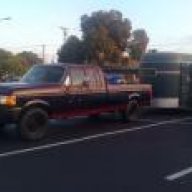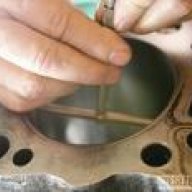
Injectors are out got pics! One looks ugly!

junk

Full Access Member
Joined
May 25, 2006
Posts
1,773
Reaction score
63
Location
Paullina, IA
Well I got my injectors pulled from the 93 tonight. 7 of the injectors don't look too bad. One was loose. It turned while I was trying to remove the fuel line. And it's completely covered with soot up to the top threads. They are all G code injectors. Dates on them are late 93 and early 94. A couple of them were discolored and one had a little bit of rusty stuff on it.

So how should I clean the bore from the sooty injector hole? I'm thinking a seat reamer and a shot gun cleaning brush? How do the rest look? This is the first set of injectors I've ever had out.

Also how the heck does a guy get the pump and lines removed from an engine with a 093 turbo system? I ended up loosening up 4 of the fuel injector lines and fought it for a while before I finally got it snuck out. Without the turbo it looks like a piece of cake.

You must be registered for see images attach

 

junk

Full Access Member
Joined
May 25, 2006
Posts
1,773
Reaction score
63
Location
Paullina, IA
Hey I forgot to say. The copper washers appear to be RTV'd to the tips of the injectors. I would describe the stuff as a copper colored RTV on them.
 

hesutton

The Anti-Anderson
Joined
Aug 19, 2005
Posts
8,200
Reaction score
742
Location
Bowling Green, KY
That rusty one looks like it was exposed to water/coolant? Was it rained on without the hood on? The injector bore reamer would be great to clean the bores, especially the one that was loose and soot covered. Problem is, they are hard to find cheap.

As far as the silicone, not really recommended. Some grease, vasoline, or a little anti-seize (what I use as I always anti-seize the threads of the injectors anyway) will hold the copper washer on the injector during installation.

Heath
 

Agnem

Using the Force!
Joined
Jan 10, 2005
Posts
17,067
Reaction score
385
Location
Delta, PA
That may have been copper based anti-seize you see there. Not recommended at all on the washer. As was mentioned, the washers should go in with a dab of vasoline to hold them on the injector, and thats it. Otherwise, they should be dry. Double check to make sure you don't have two copper washers in that bore. Whoever installed that one, didn't do it right.

I always manage to get the IP in and out with the lines still attached. It's a bit of a puzzle sometimes, but you can usually figure it out.
 

junk

Full Access Member
Joined
May 25, 2006
Posts
1,773
Reaction score
63
Location
Paullina, IA
Yeah I just looked and I ended up loosening all but two of the lines, one from each side. I'm normally really good at sneaking stuff out of goofy spots, but this one got the better of me. I'm going to put them all back on and see if I can't sneak it back in. I almost had it, but part of the pump kept getting caught on a cast feature on the pump gear cover. I was probably being too easy on the lines, but I didn't really want to break any.

On the injectors there's no way I'm using RTV on the copper washers, but just saying that appears to be whats on them. It's thick and rubbery like dried sealant. Versus loctite is normally still slimy it never really sets up. There is definitely grey loctite on the injector threads.

Not sure whats up with the rusty one, but I'm not overly worried about coolant problems which was my first fear. It definitely wasn't wet still. Wondering if it's rain water from the hood seam. It was the #8 injector that had the rust.

I have to inspect the bores still and look for any seat damage. I know the ford seat cutter is hard to find. I wondered about using like a flat end mill to touch up the seats if needed. I have access to all sorts for machine tools at work so I should be able to get an end mill the right diameter.
 

icanfixall

Official GMM hand model
Joined
Apr 10, 2005
Posts
25,858
Reaction score
681
Location
West coast
Junk... I have made a viedo of how to remove an injection pump from an engine with a Banks sidewinder turbo on it. I leave the lines on but the throttle cables and brackets needs to come off. also the fuel pump to injection pump feed line has to come off. Once its all unbuttoned just push it towards the air inlet of the intake manifold. Twist it towards the passenger side and withdraw up thru thre teo studs on that side of the gear cover. Works well every time. Someone may find it and post it here for you.
 

junk

Full Access Member
Joined
May 25, 2006
Posts
1,773
Reaction score
63
Location
Paullina, IA
Ok tested the injectors today. Not sure exactly what I was looking for bu here's what I got. None of the spray patterns looked good. They were all spraying a mist but it was always spraying at some weird angle. Six of the injectors popped at 2500 while the last two popped at 2000. After they popped two of the injectors bled down to 500 psi or less right away. 5 of the other ones bled to around 1250 psi quickly while the last injector stayed around 2000 psi.

So I wasn't sure what I should be looking at but even with just the spray patterns and unevenness in pressures they seemed bad to me.

I have a rebuilt pump and new injectors I bought from another forum member. I'm hoping to pop Test the new injectors before putting them in. Just to verify they have the same pop pressures.
 

icanfixall

Official GMM hand model
Joined
Apr 10, 2005
Posts
25,858
Reaction score
681
Location
West coast
An injecter that developes a drip after pumping it up is ok if the drip does not fall off before 5 seconds. If the droplet is hanging after 5 seconds its ok. Dry is what you really want but this information came from my international shop repair manual.
 

icanfixall

Official GMM hand model
Joined
Apr 10, 2005
Posts
25,858
Reaction score
681
Location
West coast
About the 2500 lbs of pop pressure... Thats too high for any pump longativity. 2000 or 2100 lbs is about the limit. These injecters have some shims in them. Each 1 thousands thick shim equals 50 lbs.
 

junk

Full Access Member
Joined
May 25, 2006
Posts
1,773
Reaction score
63
Location
Paullina, IA
Yeah I'm questioning the 2500lb pop pressure. Seems really high. I would have expected them to wear down not up. The guys I bought this truck from said it "had injectors done". I'm questioning if they had some shop "rebuild" the injectors and just went crazy on the pop pressure on the rebuild? Other than the high pop pressures I would have thought these were the original injectors that came with the truck.

Regarding an injector seat cleaner I have a lathe and access to cutting tools. So I'm thinking I could make one. My question is what diameter is the ford rotunda seat cutter? I would like to match that. I'm assuming it's slightly larger than the copper gaskets.
 

G. Mann

Full Access Member
Joined
Apr 13, 2007
Posts
927
Reaction score
86
Location
Phoenix, AZ
Just so happens, in my past life, I was a FAA Certified :hail Jet Engine Fuel Systems Repair Station owner. Still hold the Repairman Certificate {fwiw]. Anyway, my point is, I've repaired and returned to service a few thousand sets of fuel nozzles.

Jet A and diesel sprays the same so I'm thinking I might give you some good answers on your question about spray pattern and condition.

In a perfect world, the spray pattern for each nozzle should be a smooth cone shape, centered on the orifice [think, funnel turned upside down]. The spray cone should be fine droplets, with no streaks or "fat" droplet areas. The nozzle should break clean at the preset break pressure, and all nozzles in the set "should" break at the same pressure, have the same size cone, and droplet size.

For jet engine work, part of our test was to physically measure the output of each nozzle, at the spray pressure over a preset time period, by weight [in grams of fuel per *** seconds of spray into a beaker setting on a gram scale] If a nozzle put out to much fuel.. or to little.... we would change the spray nozzle size and or shim opening to adjust it to limits. [Yes,, it was like pulling mouse teeth after the first coffee break]

The objective was to have each nozzle as exactly like all the rest in a set. We then had to assemble the full set and do a spray measurement for the full set, for volume of fuel to make sure we met specs for that.
[think power output and fuel economy].

The preset break pressure has two limits, an upper and a lower. The upper limit opens the spray. The lower limit should close the spray.Both should be clean breaks, ON and OFF. + or - the allowable design limit for the type of nozzle. [per IH or Ford in this case]

Your mileage may vary....... Hope this helps.;Really
 
Last edited:

junk

Full Access Member
Joined
May 25, 2006
Posts
1,773
Reaction score
63
Location
Paullina, IA
G. Mann thanks for the explanation. The upper and lower limit explanation here makes sense and was what I would expect.
 

junk

Full Access Member
Joined
May 25, 2006
Posts
1,773
Reaction score
63
Location
Paullina, IA
Ok, I got the new Delphi BB injectors. I tested them before installing. They all popped right around 1800 PSI as I would have expected. It was interesting because when they popped they stayed right around 1800 PSI. So I retested my old injectors and they would start popping at 2000 and then continue to release fluid and build pressure until 2500. So I'm assuming they were all plugged with stuff and couldn't flow appropriate volume at a reasonable pressure and kept building. There were also a couple that were definitely dripping way before popping.

I also found another copper gasket in the #1 injector hole. So the number one injector had 2 copper gaskets. I blew all the stuff out the injector bores and they all looked good so I put all the new injectors in last light using anti-seize on the threads. I also replaced the passenger side valve cover gasket and put new Olives i the turbo oil feed line. I had previously replaced the drivers side valve cover.

So total parts being replaced this time around.
1- MWFI rebuilt injection pump
8- Delphi injectors
1- motorcraft thermostat
1- Lift pump
2- Valve cover gasekts,
1- CDR valve
1- Filter head one-way valve
2- turbo oil line olives
3- fuel line olives

After all this it should run really nice. Hopefully my oil consumption cleans up after I get the good injectors in there and fixed a bunch of possible leak points. All of the gaskets have been super hard and brittle.
 
Top