
MidnightBlade
Shiftin' Smooth
What all is possible to do to the stock heads to get a few more ponies out of a 94 factory turbo? Set all costs aside, just looking for some insight on a future build ill be working on.



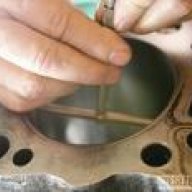
Cleaning up the castings to a smooth surface is never a bad idea. Gary will be along to fill you in on his experience with working on the ports.
Heath
 I make the time to polish both the intake and espesically the exhaust port. Reasons for this work more on the exhaust is this.. Cold air in is one thing but hot air out is completely differant. I can add more inlet pressure to force more air in. turbo or supercharger is how. Now get that expanded hot air out is a differant animal. No matter what you have both sides of the inlet and exhaust with a turbo will be under pressure. Say you have 15 lbs on turbo boost. Thats 15 lbs sitting on the closed intake valve. Now the valve opens and the cylinder fills with this 15 lbs of air... No chance you use up all the stored air pressure in the intake either. That pressure is waiting there as long as the turbo is pumping it out. This added pressure to the air charge is tremendosely high. That piston is about 4.100 inches below top dead center of the stroke. Now its compressing all that already pressureized air into a space that around 42 thousands at the top of the stroke.. Just that thought is enough to give us a stroke.. Wow... Now the fuel is injected into this hot air.. BTW that air must be at least 942 dgress for the ignition of the diesel to take place. After that the piston is racing down powering the crank. Near the bottom of the stroke the exhaust opens. Some hot exhaust is now escaping but most of it will be pushed out as the piston reaches the top end of the stroke again. This hot air is going into the hot side of the turbo power end. The larger you have the exhaust port to its allowable limits the better it allows the engine to braeth. There is lots more but this gives you an idea of what to ask others that will port these heads... Now one word of warning. Porting a gasser head is so much differant that porting a diesel head. A diesel has no fuel being dumped into the intake manifold like many carbed engines. Those intake ports can'r be polished much more than 300 grip wet & dry paper or the gas will bead up on the walls. Then it droplets into the air flow causing all kinds of hell in the combustion chambers. We just push air into a diesel. Nothing more. Actually we can run without an intake manifold. Just suction off the heads and our idi will run fine... Keeping the air filtered clean is another item. Thie tools needed for porting are simple tools and sanding rolls made by 3M.. I used the horrible freight rolls and they were **** in my hand.. They unrolled very quickly. I'll never use thenm again... Its 3M or nothing. The final polish is done with a special scothbrite flower. They are expensive but do a great job ob the cast iron...
Gary is there a area of the exhaust port that a person should really stay away from when porting???
As far as water jacket areas??

The easy answer is yes and no... This is what I mean... Looking at the exhaust port as the head sits on the engine. That top mount there is no cooling surrounding that area. Only under the floor of the exhaust port and the sides is there coolant working on them. At the thinnest area of the roof the cast iron is just over 3/8 thick solid metal. 3/8 equals 0.3750. To measure this you need a very special dial caliper to reach in for this. Nice tool to have too. So any material removel on the top should be little more than cleanup to the surface finish you want. But as for the radius just after the seat you need to smooth that out to increase flow. I use a burr on the back side. I can supply the type later on but its best done opposite of the normal way we use a burr on the tip. Remember these are not gasser engines where porting can ruin the heads. Also we never turn much higher rpm than 3500 rpm. So push this higher and get away with it but for how long is still up for thoughts. These bottom ends are heavy and designed for about 3800 rpm max. I think Mel can tell you what the pumps are going at that rpm. Our engines rpm is decided by the amount of fuel being pumped into it. No throttle body or carb butterflys cutting off the air. We want fuel for power and rpm. The design of the injection pump is to get fuel to the engine and limit the rpm be gorener taking fuel away from the engine at the pumps designed rpm red line. Recall some idi engines like found in a bus or big rig dump truck have a red line of around 2500rpm. Install an injection pump off a pickup truck with a differant gonener spring and see that same engine rev to 3800 rpm. Then go a litle more and install a gm gonener spring and see the rpm jump to 4400 rpm... Smar engine doing much more rpm just by a spring change...
I have access to a flowbench and all the tools required for the port and valve work, one of my good friends is alao a pro at port and machine work so this will be a very low cost build. Im also pondering the design of some custom intake and exhaust manifolds for better flow to and from the head. If everything goes well, ill be getting the heads pulled and start the porting tonight after work