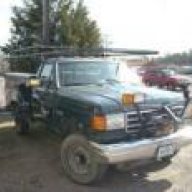
I see you may have a highly modified version of a Ford pickup. Lets start from the beginning again.
Everything is new except the wheel cylinders and booster, are we dealing with the rear wheel cylinders and, this is a vacuum booster not a Hydro-boost system?
When you replaced the various parts on the braking system did you flush the entire system, rear included? Contaminates may be in your system slowing taking out your Master Cylinder causing internal leakage between the front and rear sections of the reservoirs. When you push the brake pedal, the MC may be bleeding back in on its self and not building pressure causing extended pedal travel. The vacuum in the booster (the hissing sound) now compensates for this by rapidly building more vacuum. Look for dirt discolored fluid in the reservoir on the Master Cylinder, if its plastic shine a flash light from the under side. If the MC is still under warranty try exchanging it for another, if not pick up a rebuild kit (normally inexpensive) for it and go through it.
Flush, Flush, Flush, the lines, cylinders, and calipers to the system. A power flusher works best for this if you have access to one if not a rubber tipped blow nozzle to blow compressed air through the lines. If all else fails grab a friend who’s bored, (MAKE SURE TO LEAVE THE OLD MC ON) and start draining it one cylinder at a time starting with the one that is furthest from the MC (normally passenger side rear) while they pump the pedal for you. Do this just like your bleeding air out of the system. This will take awhile as when you think your done do it again, dirt and particulates will travel back and forth in the line as the pedal is worked. When you collect the old brake fluid, you can run it through a coffee filter to clean it up to continue flushing the lines.
KEEP IT CLEAN LOOK FOR WATER AND ANY THING EALSE THAT LOOKS OFF. IF IN DOUBT DO NOT REUSE IT TO FLUSH. When you install the new or rebuilt MC run fresh fluid through your system one more time using new not filtered fluid. I’m including a link that may help you to understand better how a booster and components work at the end of this. Hope this helps.
 http://en.wikipedia.org/wiki/Hydraulic_brake