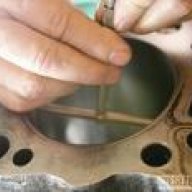
What it looks like its doing is there is a line at the bottom of each tank connecting eachother, and a line at the top connecting each so it basically is just functioning as one big tank.
If that be the case, then it has been converted to function like the saddle-tanks on a big truck; an equalizer line connects all tanks at the bottom, such that they all empty together, like you said = functioning as one big tank.
I would trace every line and identify for certain what each line does.
To work properly, it should only have one main DRAW point, as in DRAW from only one tank, even though they are all connected at the bottom.
The same goes for the main RETURN; it should RETURN only into whichever tank it DRAWs from.
ALSO, there should be a SHUT-OFF VALVE in the bottom line between tanks, preferably TWO shut-off valves, one per tank at the point where the bottom line exits each tank.
Without the shut-off valves, when both tanks are mostly FULL, seeing as how the fuel is going to seek the lowest level, should the truck be on an incline, the fuel will run to the lowest tank and
over-flow it.
Here is how it should work:
You turn OFF one or both cut-off valves and fill both tanks FULL.
You drive on the one tank that has both the DRAW and RETURN, just like you had only one tank.
When the fuel level gets down to around 1/4-tank, at the next stop you open the cut-off valve(s), thus allowing the fuel from the FULL tank to flow into the near-empty DRAW tank, with the fuel level equalizing at around 5/8 to 3/4.
With the level of one tank down to 1/4 and the other FULL, it is then highly unlikely that the truck would be inclined enough such that either tank could overflow.
Of course, it is also remotely possible that all the fuel could flow to the AUXILLIARY tank and leave the DRAW line high and dry, thus running the engine out of fuel, but this is highly unlikely, unless the truck is parked on an awfully steep grade.
If it is plumbed to function as I described, complete with the cut-off valves, then I would leave it alone, as such a system is superior and far more trouble-free than the silly problematic always failing electric selector valve, which failure is most likely why it was changed in the first place.


 also my fuel gauge is pegged "full" Iv only put 85 miles on this truck since Iv had it and I the gauge hasnt moved.