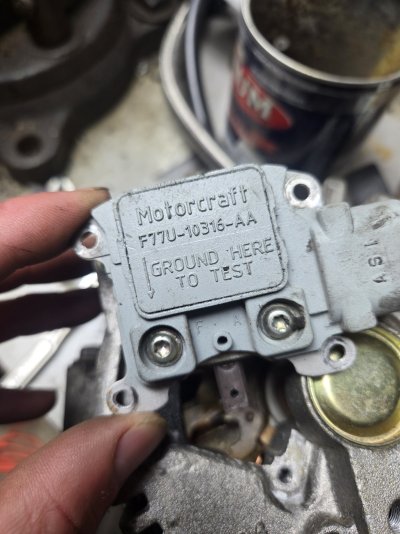
I believe that ground text on that regulator connection is to show you what terminal to touch to ground with a test wire. This bypasses the regulator output, forcing the alternator to full output. It is used to verify if the alternator can provide power. If engine running, you should see a lot of current go to the battery, voltages increase, lights brighten, etc.
The other terminal should go to key-on power. Do not ground it, but you may verify with a voltmeter that you have battery power available there when you have key on.
The reason for key power is that with the engine off, the alternator can't generate any current with no mechanical shaft work to spin the armature. The voltage won't come up, the regulator will try to drive armature current to call for more output , which won't happen. No shaft work - no power out. So the regulator will continue to fruitlessly use battery current to power the armature until the battery dies.
It's a quick way to find out why no power. If shorting the indicated node to ground while the engine is running brings power full on, it's obvious the regulator is holding it back.
This is when clamp-on DC a meters ( optional ) come in handy for measuring the response, but for practical purposes just a quick touch is sufficient. Don't wire to ground as a "fix". A battery overcharge will be inevitable.