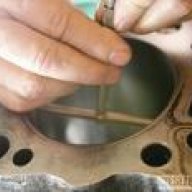
Sleeving a block & piston locations

fordf350man

Full Access Member
Joined
Nov 3, 2012
Posts
838
Reaction score
1
Location
Rockwood MI
well the proof is there with synthetic oil that can be researched easily, i have never researched gapless rings pros and cons but from what i was told they are pointless, like i said i am taking the word from a performance engine builder, he isnt a mechanic in a shop that does engine repair, all he does is build performance engines, do you have any proof that gapless rings are good to use? most people i know and myself included have always gapped the rings, i mean gapless rings seem to me as the lazy way out, less work involved to install them, myself i would rather take the time and ensure my engine is together properly instead of just slapping something in there and saying its ok
 

Brad S.

Full Access Member
Joined
Nov 28, 2010
Posts
1,603
Reaction score
2
Location
NW IA
Thanks all for the info.
The reason I bring gapless rings up, I've heard they keep the oil cleaner, but if they don't last as long...????
I'm sure there are many on the OB that have rebuilt engines with regular rings and have "clean" oil.
Another question on rebuilding, do steel cylinder sleeves reduce friction on the rings???
Thought I read it somewhere that steel gives less drag then cast iron...???
 

riotwarrior

Full Access Member
Joined
Sep 19, 2006
Posts
14,782
Reaction score
492
Location
Cawston BC. Canada
Thanks all for the info.
The reason I bring gapless rings up, I've heard they keep the oil cleaner, but if they don't last as long...????
I'm sure there are many on the OB that have rebuilt engines with regular rings and have "clean" oil.
Another question on rebuilding, do steel cylinder sleeves reduce friction on the rings???
Thought I read it somewhere that steel gives less drag then cast iron...???

Ok lets slow down the this is better than that cause I got told this by that guy thing and deal with what is evidence not hear say.

I'm not wanting to see this thread go down hill I've rather enjoyed this thread.

Now with that being said lets go back to the question here about sleeves and reducing friction on rings.

Now don't quote me, however if I remember correctly, there are three different hardness of sleeves available for our engines.

That being said, the differences are for matching up to rings and providing the longest and best engine one can...now this is just going off my memory for researching sleeves. Please do your own research and draw your own conclusions do not base your choices on my memory. LOL

As for GAPLESS rings, they have a purpose and place just as any other specialized part does.

Lets look at this for the sake of auto manufacturers first. The simple gapped ring is inexpensive, simple to install and reliable for many hours/miles of use. Why fix what isn't broken? Why increase cost not only to manufacturing but to consumers for a moderate gain at best to the general public.

Now take a look at a more specialized clientele, say you me and joe going to build a performance engine dude...

NA engines, well they are just that...NA no big deal right blue print the engine pick the best ring for the purpose, again here we can make choices more refined...be it cast or plasma moly spray faced etc.

Forced induction, hmm...now we have a vent in the rings gap that allows pressure to not be sealed and subsequent loss of power and increased contamination of oil. Perhaps now it's time to look at Gapless rings and there are more than one type of rings BTW. They don't increase drag, they do increase seal, you can go from...for example 7-10% leak down to damn near 1% leak down with a gapless...that's 1% loss of cylinder pressure compared to 10% on new engine that is broke in.

So if your new engine is giving and this is an example 450lbs cranking compression on a compression test, that is inclusive of 10% loss of seal, what would that equate to? I"m not good at math here so help me out but I think its 500 lbs compression...so lets look at that number now at 1% loss is 495lbs so what does that equate too?

A loss of 10% power going out the road draft tube is what it equates too!

Now this is just a theory based argument one of which I've personally seen the results similar to what I've discussed albeit in a gas engine that Bill built many years ago.

So there is a place, and a purpose for certain items in engine building.

Some people are against change due to lack of positive experiences with change, or lack of knowledge about them.

I'd really recommend, that you personally get a hold of sealed power and discuss with them the pro's and con's of a gapless ring in your engine. Then return here and post what they say. Compare that info to what you can research on the web.

Bottom line, if you are going to sleeve the block install new pistons, then I'd suggest the more you research and learn the better you are able to make informed decisions that will provide you a long strong running engine.

JM2CW

Al
 

icanfixall

Official GMM hand model
Joined
Apr 10, 2005
Posts
25,858
Reaction score
681
Location
West coast
From my work in the area of sleeve material I have found this. L.A. Sleeve offers three differant hardness sleeves for most engines. Our idi included. Its soft, normal and hard. Now for ring compatablility. a soft ring on the hard sleeve will wear the ring before the sleeve. Thats a good thing in the long run because the rings are cheaper and easier to replace than a sleeve. Run the soft ring with a normal sleeve and it wears down slower but it does wear more than the sleeve. Running a soft ring on a soft sleeve is not a recommended thing. Then you get into plasma coated rings and cast iron rings and chrome plated rings and its almost the never ending story. Asking questions of someone that has first hand knowledge about this idea of yours is very important. Believing them is silly until you verify it by other sources. Thats your back up insurance your doing what will work. Simply throwing parts at an engine will not have a good outcome in the long run.
 

Brad S.

Full Access Member
Joined
Nov 28, 2010
Posts
1,603
Reaction score
2
Location
NW IA
Al,
Your last thought is what I've boiled everything down. "Long strong running engine"
It's nice to have power & get up & go, BUT IMHO it's even nicer to have a engine thats good on power and extremely reliable.
Thats because I don't need a lot of power.
Here are some of the things I think I need in this engine, for the way I will use it.
Piston & ring combination that keeps oil contamination to a minimum. Because I'd like to use synthetic oil.
Sleeve engine to keep away from cavitation and long wear of rings.
Balanced engine= even bearing wear, maybe little more mpg from "freed up" power & light right foot on the throttle.
Reason 1 = I do a lot of daily driving, not much pulling, not real high exhaust temps, etc. Like to think that synthetic oil would keep coking around the pistons down.(see above pics of pistons) Also easier starts in winter time.
Reason 2 = Been using wmo blend as fuel to keep costs down, plus I kinda like making "fuel", (hobby, etc)
I don't think the thread is going bad, I kinda like hearing experiences or pieces of info someone else.
I am going to talk to my machine shop, that will do the work, about all these questions.(depending on cost, they might assemble it as well)
Plus there is a local guy that has his own repair shop, had been a field service tech for local CAT dealer, talk to him about these items.
Thanks everyone, keep up the posts & experiences.


Gary, thanks for the info, I was typing in the first part of this post.
 

Forum statistics

Threads
92,932
Posts
1,155,156
Members
26,432
Latest member
pwillis

Members online

Top