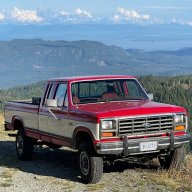
Trashnomancer: Are you decided on what platform you want to build on? I'll base my suggestions on a 1980-96 ford F-250HD but feel free to ignore this if you want to go in a different direction.
I like the idea of composites but once you start taking off fenders, hood, doors, etc, you'll find that there isn't a whole lot of weight savings. A cab&chassis concept might be enough for what you need. Oh, and avoid adding anything that would increase the frontal area of the truck.
Run stock tires. 235/85/16s are just about the best compromise for a truck tire that needs to be good both on, and off road. Bigger tires do nothing for fuel economy on pavement, and will put more strain on the running gear when you leave the pavement.
I might get linched for suggesting TTB, but it won't raise your truck has high off the ground compared to a D60, which will save some MPGs when on pavement. Just something to keep in mind.
There is room for at least one saddle tank on the passenger side, but you can also swap out the rear tank with a deeper one, provided you have somewhere else to put the spare tire (i.e. front bumper)
Engines:
I'd start with a good 1985.5-up 6.9L engine core. 1987 with the newer style rockers would be ideal but its not as critical as many seem to think. You can always change over to the newer style rockers but I haven't had any issues with the older style.
Why go with a 6.9 instead of a 7.3L? The 7.3 has hotter running heads that can negate the advantage of running an engine with bigger head bolts. The 7.3s are simply more prone to overheating than the 6.9s so I'm not convinced your head gaskets stand a better chance in a 7.3 compared to a 6.9.
Another hit against the 7.3 is the positioning of the glow plugs. The 6.9 allows a small fraction of injector spray to hit the glow plug directly, the 7.3 doesn't. In theory it might get slightly better MPG out of the 7.3 design once warmed up (likely a trade off with slightly lower CR the 7.3 came with) but it gives the 6.9 the advantage for cold starting if you're out in the middle of no-where.
If range and fuel economy is a concern, don't drop compression ratio on the 6.9. Yes, 22.5:1 is high if its turbocharged, but if you cap your boost at 10-15 PSI, and stud the heads, there will be plenty of power for where you need to go and pose no significant risk of a head gasket failure.
Run an intercooler and a nice wastegated turbo of your choice. Non gated turbos might theoretically run lower EGTs under full load, but you will never match the low end torque of a gated setup.
Use code BB fuel injectors and a good quality injector pump. Just about anyone here will vouch for Agnem's moose line of pumps - including me

Depending on how much you're willing to sacrifice for fuel economy, there are a few more options:
Serpentine belts are more efficient, but if any one accessory or pulley goes, you're stranded.
12V Electric vacuum pumps and even power steering are available. Diddo with electric cooling fans. The idea with electric accessories isn't that they will out perform the mechanical equivalent, but they come on only when needed. So on long paved roads, you don't really need the vacuum pump turning constantly. Electric power steering can be tuned for reduced power at high speed to have similar results. As for fans, I don't even run a fan in the winter on my truck.
Regarding the cummins,
I'd caution against running alternative fuels like bio, WVO or WEO with any DIRECT INJECTED engine. DIs work great for what they were intended to do. However IDIs give more time for the fuel to burn because combustion begins in the prechamber before reaching the piston crown. This means less chance for unburnt fuel to get past the crown and reach the rings were it could cause coking or in some cases, a seized engine. Alternative fuels generally have higher ignition flash points and could pose problems if used in a DI engine. IDI systems are just more forgiving because they were designed back in the 1920-1930s when fuel injection couldn't be anywhere near as precise as it is today on computer controlled engines.